Jaci Houston
Professor Matzke
DH-100-01
4 May 2025
Artificial Intelligence in the Healthcare Industry
Imagine you’re a patient in a hospital and doctors don’t really have an idea as to what’s wrong with you. But then, the doctors use artificial intelligence to diagnose your symptoms and that got you to a treatment plan and on your way to feeling better. Artificial intelligence is a set of technologies that allows for computers to be able to respond as how humans would respond. Others may argue that artificial intelligence is harmful to the healthcare industry, but by looking at present innovations and future possibilities across multiple hospitals and researchers, we can see that artificial intelligence is extremely helpful to the healthcare industry, which we otherwise might not see. AI can help diagnose patients sooner, get them treatment plans, and even assist in surgeries where surgeons cannot.
Artificial intelligence’s concept was introduced in 1956 and John McCarthy was the first to use the term artificial intelligence. However, Alan Turing introduced something called the Turing Test in 1950. This test was brought about to see if computers can exhibit human intelligence in the same way that humans do. The test involves a human interrogator, a human and a computer. Then, the human and the computer have to type responses and the interrogator has to determine who is the human and who is the computer. The computer passes if the interrogator can’t distinguish who is who. In Turing seminal paper he wrote in 1950, he mentions how “the machine can only do what we know how to order it to do,” meaning, yes, he was proving his point that machines can think, but only enough of what we tell it to do.
AI has become a helpful tool in the healthcare industry. Before medical professionals and researchers use it in the healthcare industry, they need to know how AI operates. AI uses machine learning to make predictions and decisions based on data rather than direct user input. Machine learning takes algorithms derived from statistical learning methods “that include logistic regression, linear regression, and random forest” (Hirani et. Al.). Not only that, but AI uses “Computer-Aided Detection (CAD) is an application of machine learning that assists clinicians and decreases the number of missed diagnoses when reviewing imaging studies” (Hirani et. Al.). AI also can detect skin pathology. With skin cancer being such a widespread problem, AI can recognize, detect, and classify issues with the skin. Just by having pictures of the patients’ nails, AI could detect onychomycosis, which is a fungal infection of the nails. In Hirani et. Al.’s article, it mentions how because of the technology advancements, AI is just going to get better and AI can already predict patient risk for disease, triage and diagnostics, genetic engineering, and more.
| Study/Case | AI Technique Used | Application Area | Key Findings | Implications for Personalized Medicine |
| Dermatologist-level classification of skin cancer [44] | Convolutional Neural Networks (CNNs) | Dermatology | Classification of skin lesions with a level of competence comparable to dermatologists | Enhances early diagnosis and treatment personalization along with increasing access in areas with low number of dermatologists |
| Patient-centered pain care using AI and mobile health tools [45] | Reinforcement Learning | Chronic pain | AI-driven cognitive behavior therapy (CBT) non-inferior to traditional CBT | Improves individualized treatment approaches and access to care |
| Improved referral process for specialized medical procedures like epilepsy surgery [46] | Natural Language Processing | Epilepsy and Neurological surgery | Detection of high-risk individuals who would benefit from epilepsy surgery | Ensuring timely and appropriate referrals for at-risk patients |
| Delineating ulcerative colitis from Crohn’s Disease [47] | Guided Image Filtering (GIF) | Gastrointestinal diseases | Improved diagnostic accuracy in complex presentation of inflammatory bowel disease | Enhanced diagnostic accuracy leading to targeted treatment strategies |
| Chemotherapy selection for gastric cancer [48] | Random Forest Machine Learning Model | Oncology | Able to predict which subset of patients would benefit from paclitaxel in gastric cancer | Development of predictive biomarkers to guide personalized drug treatment regiment |
pmc.ncbi.nlm.nih.gov/articles/PMC11122160/.
This table shows different case studies that have been done and what AI technique was used to aid in that case. As you can see, it shows the key findings in each case, resulting in things such as early diagnosis and treatment, ensured appropriate referrals for patients, and guided personalized drug treatment regiment.
AI analyzes certain data, such that classifies cancer. For example, “analysis of large amounts of health data stored as text data… might utilize Natural Language Processing (NLP) techniques, but analysis of medical imaging… might utilize computer vision techniques” (Hirani et. Al.). Not only that, but AI can remove noise from CT scans, which improves the quality of the image, and that helps to diagnose and treat the patient better. If AI wasn’t there to help clear that image for the patient, the doctor could potentially misdiagnose or go down the wrong treatment plan, leading to bigger problems down the road. On CNBC, they did a news segment on how AI is impacting the medical field. The video brought up good points, such as having an “AI safety net” in the operating room. With their AI, they’re using it to compare their procedure video with a different procedure that was done, and AI analyzes it and determines what steps were the best to take for that surgery, to ensure the patient’s health. “Reviewing and analyzing surgery videos can sometimes take surgeons months but this AI helps them instantly” (CNBC Boorstin). The AI that they were using for those procedures can even predict a complication or cancer recurrence. Even outside of the operating room, in 911 calls, AI is being used. Using AI to perform surgeries is a whole other level. By using AI, there’s enhanced precision, there’s “greater dexterity than the human hand could provide” and can “operate with extreme accuracy, even within tight spaces, minimizing damage to the patient” (Vazirani). In other areas of surgery, such as brain surgery, AI can “help adequately predict blood flow patterns, and complications before they happen,” so this allows the surgeon to take the lowest danger route to avoid complications (Vazirani). Also, by using AI to perform the surgeries, they’re minimally invasive, making recovery easier for patients. According to the National Institutes of Health, it indicates that robotic surgery delivers “improved patient outcomes” across a wide range of surgical procedures. Technology and AI have come so far, that these surgeries that they’re performing minimally invasively now, would’ve been a much larger surgery ten years ago. AI can be used in surgeries for urology, gynecology, cardiothoracic, and neurosurgery. In urology, it’s used for kidney stones and prostate removals. In gynecology, it’s used for fibroid removal and hysterectomies. In cardiothoracic, it’s used for bypass surgeries and heart valve repairs. Without having the AI to assist in these surgeries, the recovery for these patients would be a lot more difficult and uncomfortable. Not every doctor and patient is on board with AI being used in the healthcare industry, and it will take a while to convince people that it does good. All in all, AI is being used to perform only positive tasks for patients and doctors.
Some people may argue that AI is being used to replace physicians, but that’s not true. In Hirani et. Al.’s article, it mentions that AI is not meant to replace the clinicians, “rather they are designed to aid the clinician with guided interpretation, thereby reducing the clinician’s false negative rate.” AI cannot replace what a human doctor can do for a patient, but it can help in places where humans take longer to find something or are lacking in something. However, there is something that AI cannot help with. “There’s a need for compassion in communication that AI is unable to contribute” (Dranove et. Al.). Even in radiology, where the job seems to be the most likely place for AI to take over, there’s still “many interpersonal changes [,such as] to discuss results with other medical staff and explain risks, benefits, and treatment options to patients” (Dranove et. Al.). All of the interpersonal and patient interactions cannot be taken from human physicians. Imaging going into your doctor’s office and talking to a computer, with no emotion or any signs of empathy. It would be a horrible experience, and AI cannot replicate empathetic emotions.
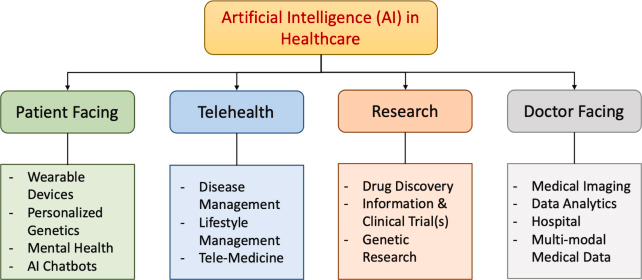
https://www.sciencedirect.com/science/article/pii/S001048252300313X.This graph here shows the different aspects and parts of the medical field that AI can make a difference in. It shows the parts of how patients can receive better care, how AI can be there for them whenever they need, and how it can help with mental health. That leads into telehealth, and from there, they can receive disease management, lifestyle management, and tele medicine. Research is a big part in AI as well, and that can help with drug discovery, different information and clinical trials, and even genetic research. On the doctor side of it, it helps with medical imaging, data analytics, and multi media medical data.
In Dranove’s et. Al. article, it mentions how if AI leads to fewer overtreatments, that leads to less procedures and you lose money. No one should be overtreated anyway, and the healthcare industry should not be a business just to get money out of people to get surgeries. It’s sad that that could be a reality for some hospitals, and if anything, AI will help reduce that problem.
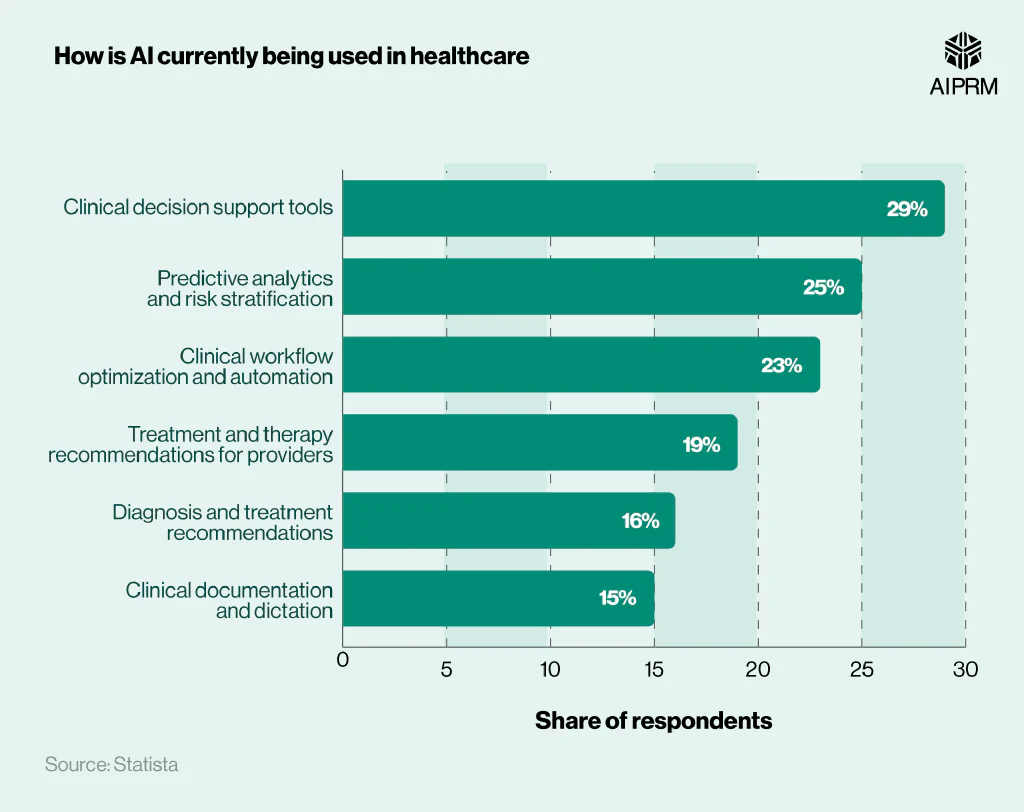
www.aiprm.com/ai-in-healthcare-statistics/.
This is a graph indicating what AI is being used for in healthcare currently, and as you can see, it it all being used for positive effects in the healthcare industry. AI is not there to harm patients or take physician’s jobs away. The highest percentage usage is 29%, and that’s AI helping in clinical decisions. The other effects AI is having an impact is predicting analytics and risk stratification, providing treatment and therapy recommendations, to diagnose, and is there for clinical documentation. It’s there to help patients and physicians to get the best patient doctor care there can be.
Others may argue that artificial intelligence is harmful to the healthcare industry, but by looking at present innovations and future possibilities across multiple hospitals and researchers, we can see that artificial intelligence is extremely helpful to the healthcare industry, which we otherwise might not see; this is important because AI can help diagnose patients sooner, get them treatment plans, and even assist in surgeries where surgeons cannot. If you had a family member in the hospital or even you, if there were ways to enhance theirs or your treatment, you’d want to take it. Luckily, AI is there to help. It’s there to diagnose patients and use data that it organizes in a way from the patients medical history that humans can’t see right away. AI is a very useful tool in the healthcare industry, and with technology advancements, it will be even better.
Works Cited
Dranove, David, and Craig Garthwaite. “Will AI Eventually Replace Doctors?” Kellogg Insight, 31 Jan. 2023, insight.kellogg.northwestern.edu/article/will-ai-replace-doctors.
Hirani, Rahim, et al. “Artificial Intelligence and Healthcare: A Journey through History, Present Innovations, and Future Possibilities.” Life (Basel, Switzerland), U.S. National Library of Medicine, 26 Apr. 2024, pmc.ncbi.nlm.nih.gov/articles/PMC11122160/.
Turing, A.M. Computing Machinery and Intelligence, 1950, courses.cs.umbc.edu/471/papers/turing.pdf.
Boorstin, J. “How AI Is Changing the Medical Field.” CNBC, CNBC, 30 May 2023, www.cnbc.com/video/2023/05/30/how-ai-is-changing-the-medical-field.html?__source=sharebar%7Cemail&par=sharebar.
Vazirani, Pravin. “Robotics & AI: Cutting-Edge in the Operating Room.” Medical Product Outsourcing, 17 Dec. 2024, www.mpo-mag.com/robotics-ai-cutting-edge-in-the-operating-room/.
Aiprm. “50+ AI in Healthcare Statistics 2024 · AIPRM.” AIPRM Trademarked Icon Black, 8 July 2024, www.aiprm.com/ai-in-healthcare-statistics/.
Khalid Junaid Qadir d, Nazish, et al. “Privacy-Preserving Artificial Intelligence in Healthcare: Techniques and Applications.” Computers in Biology and Medicine, Pergamon, 5 Apr. 2023, www.sciencedirect.com/science/article/pii/S001048252300313X.